
A Mississippi Genealogy & History Collection
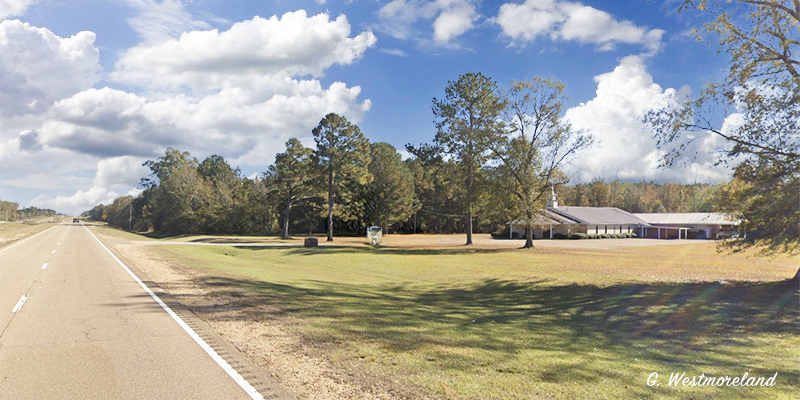
Lucas is a small, unincorporated community in Jefferson Davis County, whose origins are closely tied to Reconstruction-era Black settlement and landownership in south-central Mississippi. Unlike many rural communities that emerged gradually and ambiguously, Lucas has a clear and meaningful point of origin rooted in post–Civil War freedom, self-determination, and community building.
In 1870, Warren Lucas, a highly respected Black settler, established a homestead along Dry Creek, approximately five miles west of Prentiss. At a time when newly emancipated African Americans were seeking safety, land, and autonomy, Warren Lucas’s settlement became a focal point for others pursuing the same goals.
The community that developed around his land took the name Lucas in his honor. Significantly, this settlement was comprised entirely of Black residents, making it a rare and important example of a post-emancipation, self-contained Black rural community in what was then part of Lawrence County (and later Jefferson Davis County after its creation in 1906).
Lucas grew in a landscape of pine timber, fertile bottomlands, and small waterways such as Dry Creek. The settlement did not develop around a railroad or river port; instead, it followed a pattern common to independent Black farming communities—anchored by landownership, kinship networks, and shared labor. Residents farmed cotton, corn, garden crops, and raised livestock, supplementing income with timber work and seasonal labor in nearby areas.
Land ownership and stability were central to Lucas’s identity. Families lived close enough for mutual aid but spread out across workable acreage, reinforcing both independence and community cohesion.
Churches and informal schools formed the social backbone of Lucas. Religious institutions served not only as places of worship but also as centers for education, leadership, dispute resolution, and social life. Revivals, funerals, homecomings, and seasonal gatherings reinforced a shared identity rooted in resilience and cooperation.
Education for children was initially local and modest, often held in church buildings or small schoolhouses. As county-wide school consolidation expanded in the twentieth century, students from Lucas were absorbed into larger systems, marking one of the first major shifts away from a fully self-contained community structure.
As the twentieth century progressed, mechanization reduced the need for farm labor, and economic pressures encouraged younger generations to seek work in towns, cities, or out of state. Improved roads connected Lucas more closely to Prentiss and other nearby communities, but also made migration easier.
Despite population decline, Lucas did not vanish. Family land remained in use, churches continued to function, and cemeteries preserved the names and lineages of the original settlers and their descendants. The community transitioned from a concentrated settlement into a quieter rural neighborhood with deep historical roots.
Today, Lucas exists primarily as a place remembered through family histories, church ties, and land records rather than through formal town boundaries. Its significance lies not in size or commercial development, but in what it represents: an all-Black Reconstruction-era settlement founded by a known individual, sustained by landownership, faith, and community strength.
Lucas stands as a reminder that many Mississippi communities were built not just around geography, but around purpose—and that some of the most enduring histories are written quietly, one family at a time.
Lucas is located on US Highway 84 about 5 miles west of Prentiss and about 9 miles east of Monticello. GPS: 31.588056, -89.958333