
 Jefferson Davis County, Mississippi
A Proud Part of the Mississippi GenWeb!
Contact Us:
State Coordinator: Jeff Kemp
County Coordinator: Gerry Westmoreland
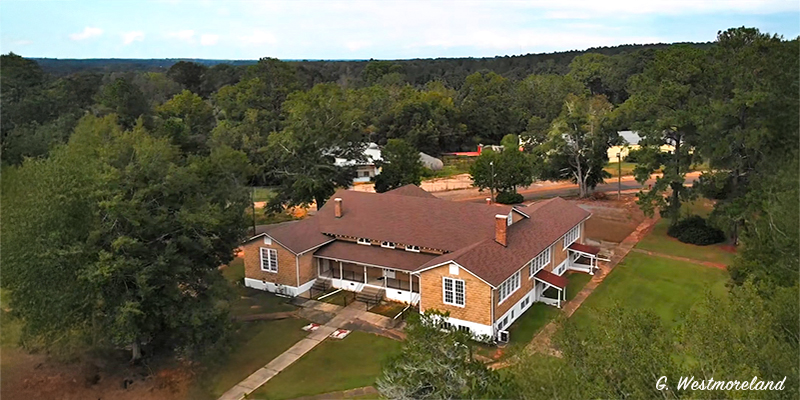
Prentiss Institute—formally known for much of its life as the Prentiss Normal and Industrial Institute (PNII)—was one of the most important Black educational institutions in south Mississippi during the Jim Crow era, rooted in the belief that education could be both a ladder and a lifeline in a state that tried hard to keep it locked away.
Beginnings in 1907: a school built for students shut out elsewhere
The Institute was founded in June 1907 in Prentiss, the new county-seat community of Jefferson Davis County, by husband-and-wife educators Jonas Edward “J.E.” Johnson and Bertha LaBranche Johnson.
At the turn of the 20th century, educational opportunities for African Americans in Mississippi were severely limited; Prentiss Institute was created explicitly to challenge those limits by providing formal schooling to Black youth who were excluded from white-run institutions.
Early instruction began on land the Johnsons purchased (often described as about 40 acres), and the campus developed from modest beginnings into a structured institution with a clear mission: build educated graduates and trained teachers, and do it while the surrounding system insisted that neither was necessary.
“Normal and industrial”: academics plus practical training
Like many Black schools of its era, Prentiss Institute blended “normal” (teacher-training) and “industrial” education. Students typically took academic courses alongside hands-on programs such as agriculture and skilled trades, as well as domestic arts—training aimed at both economic survival and community leadership.
Over time, the Institute also functioned as a county teacher-training school, supplying instructors for rural Black schools across the region.
Campus growth: buildings, Rosenwald support, and a larger footprint
As Prentiss Institute grew, so did its physical plant. A notable milestone was the construction of a Rosenwald-funded classroom building on campus in 1926, part of the broader Rosenwald effort that helped finance thousands of Black school buildings across the South.
By the mid-20th century, accounts describe an extensive campus operation with multiple buildings and significant agricultural land supporting the school’s programs.
Junior college era and mid-century peak
A major academic expansion came in 1931, when Prentiss Institute became a junior college. By the 1950s the school reached its high-water mark—often cited as around 700 students—and it gained a reputation as one of Mississippi’s leading schools for Black students.
In the 1950s, the Institute also ran agricultural initiatives including a Heifer International dairy program (notably reported as benefiting needy families, including some white families in the area).
Transition after public-school expansion, then closure in 1989
As Mississippi’s public education landscape shifted, Jefferson Davis County opened a public school for African American students in 1959; afterward, Prentiss Institute phased out its elementary and high school levels and leaned more heavily into the junior-college focus. Over subsequent decades, enrollment declined, and the Institute ultimately closed as an educational facility in 1989.
Preservation and today: landmark campus and community center
Although classes ended, the campus did not simply vanish into kudzu and memory. The site is recognized for its historic importance (including buildings tied to the early campus and a broader historic district), and the Institute has continued in various community-serving roles—hosting gatherings and organizations and supporting ongoing preservation efforts. A modern nonprofit effort, led by trustees and alumni supporters, has worked to restore and repurpose the campus while honoring its educational legacy.
G.W. Carver Elementery School is located in Prentiss at the intersection of E. St Stephens Road and J.E. Johnson Road. GPS: 31.591944, -89.856944